
You’ve read the bestselling self-help books. You highlighted the passages. You bookmarked the pages and nodded along, genuinely inspired. Then you hit the end-of-chapter assignment (“Take this assessment right now before moving on!”) and you thought, I’ll come back to that.
You didn’t.
Not because you didn’t want to, or didn’t believe it would help, but because you didn’t build in extra time for it. Without a designated time set aside for inner work, even the best intentions quietly evaporate. Sound familiar?
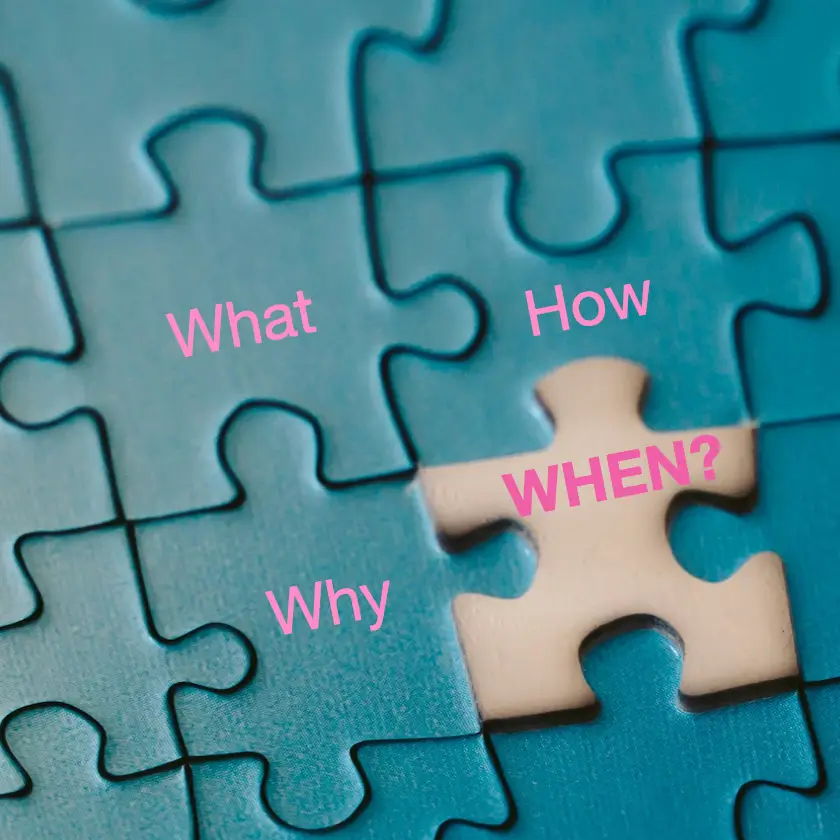
Self-help gurus are brilliant at telling you what to work on, how to do it, and why it matters. But there’s one question they almost never answer: when?
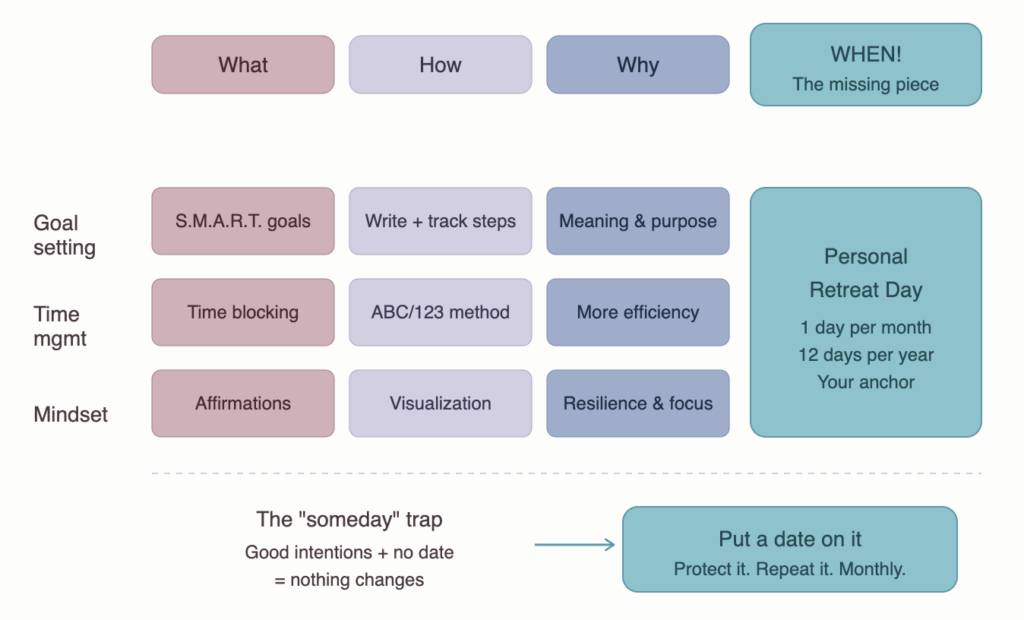
Here’s the framework most self-help books follow and where they stop short. The WHAT consists of tools for self-improvement, such as goal setting and time management. HOW gives step-by-step instructions on achieving success with these tools (how to set S.M.A.R.T. goals, how to prioritize your activity list). And WHY points to the results you hope to get from applying these techniques. For example, reasons for managing time wisely are to increase efficiency and be more productive.
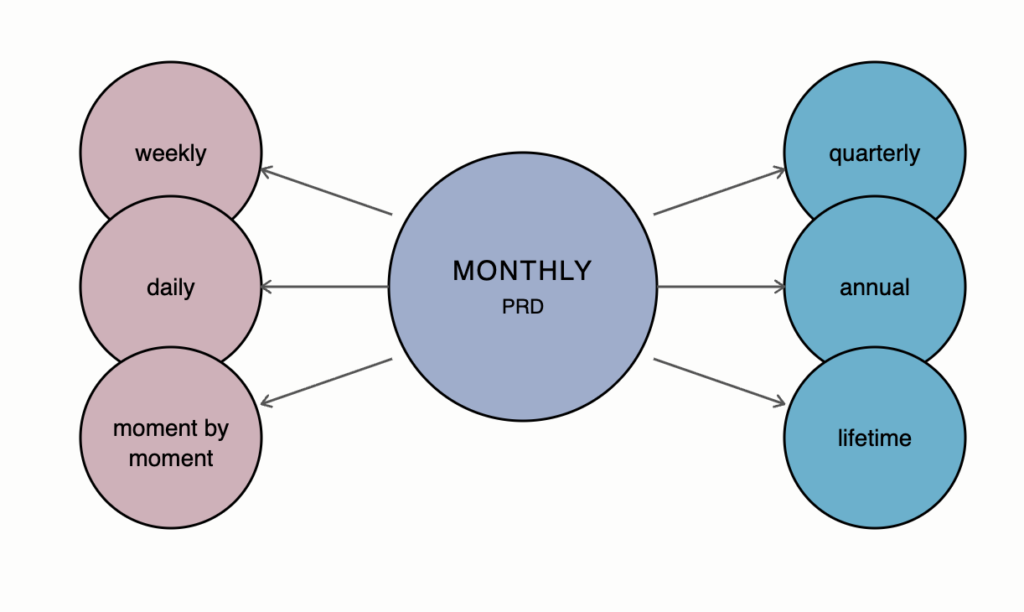
The missing question is WHEN. When exactly should you work on these tools and techniques? Naturally you want to be working on self-improvement constantly, but that’s a false answer. In my experience, you must intentionally set aside designated blocks of time to devote to your personal development and well-being. The secret is preserving one day a month to focus on personal growth. Your Personal Retreat Day (PRD) serves as an anchor to create weekly, daily, and moment-by-moment habits as well as to paint a broad picture of the distant future.
Here’s an example of how my PRD helped me follow through on a good self-help technique. One of my favorite books is Essentialism by Greg McKeown. One brilliant idea in the book is creating a set of criteria that must be met for an opportunity to be a “yes.” As a freelancer, I realized working on my criteria checklist would be a valuable use of my time, but I was in the reading zone, not the doing zone. So I put a post-it note on the page and saved it for my next Personal Retreat Day. I created my criteria list when I had real time and focus, and I still use it to this day to say “no” to projects that aren’t a good fit (and “hell yeah!” to the ones that are!)
Once a month is the perfect timeframe to notice patterns and pivot to what’s next. It’s the sweet spot where you can see both the forest AND the trees, between the big picture and the nitty-gritty details. Setting aside one day a month gives you 12 opportunities over the next 12 months to create a “rest stop” where you can review what’s just passed and preview the next several weeks. Reflecting on a 30-day period is realistic. You can easily recall the significant events, the highs and lows, from the month that’s just passed. Same with looking forward: it’s easy to paint a picture of the next four weeks in broad strokes. The key is repeating this month after month after month.
Knowledge isn’t the problem, the calendar is. So stop waiting for a quiet season, a less busy month, the mythical “someday” when everything settles down. It won’t. Pick a date. Put it on the calendar. Guard it like it’s the most important meeting of the month, because it is! Twelve days a year. That’s all it takes to stop drifting and start designing your life with intention.
Someday is not a date. Make it one.